
Daftar Isi
English Learning Material | SMP / Junior High School | Phase D – Kurikulum Merdeka
Pernahkah kamu mengirim pesan WhatsApp kepada teman untuk mengingatkan tentang PR? Atau menerima pesan dari ibu yang memintamu membeli sesuatu sepulang sekolah?
Nah, pesan-pesan sederhana seperti itu merupakan bagian dari kehidupan kita sehari-hari. Dalam Bahasa Inggris, pesan singkat seperti ini dikenal dengan istilah Short Message.
Melalui materi ini, kita akan belajar mengenal apa itu short message, tujuan penggunaannya, bagian-bagian penting, kaidah kebahasaan, serta berbagai contoh yang dekat dengan kehidupan siswa SMP di Indonesia. Let’s get started!
1. What Is a Short Message?
A short message is a short written message that we send to someone to share information, give instructions, ask for help, remind someone, or say something important. In our daily lives, we often send short messages through WhatsApp, SMS, or even small pieces of paper.
For example:
- You remind your friend to bring an English dictionary.
- Your mother asks you to buy something after school.
- Your classmate tells you that tomorrow’s basketball practice is cancelled.
- Your teacher reminds you to submit your homework.
In simple words: A short message is a simple way to say something important without writing too many words.
Short message tidak harus selalu berupa SMS. Catatan kecil yang ditempel di meja, pesan WhatsApp, maupun memo juga termasuk bentuk pesan singkat.
2. What Is the Purpose of a Short Message?
We write short messages for different reasons. Here are some common purposes:
| Purpose | Meaning | Example |
|---|---|---|
| Giving information | Memberikan informasi | The meeting starts at 10 a.m. |
| Giving instructions | Memberikan petunjuk | Please bring your book. |
| Giving reminders | Mengingatkan | Don’t forget your homework! |
| Asking for help | Meminta bantuan | Can you help me? |
| Asking permission | Meminta izin | May I borrow your ruler? |
| Inviting someone | Mengajak seseorang | Come to my birthday party! |
| Saying thank you | Mengucapkan terima kasih | Thanks for your help! |
| Saying sorry | Meminta maaf | Sorry, I can’t come today. |
In short, we use short messages to communicate quickly and clearly, especially when we cannot talk to someone face to face.
3. The Important Parts of a Short Message
Satu hal yang perlu dipahami: tidak semua short message memiliki format yang sama. Bentuknya bergantung pada media, tujuan, dan siapa penerimanya. Untuk pembelajaran SMP, kita dapat mengenalkan tiga bagian utama berikut:
A. Receiver / Addressee
The person who receives the message. Artinya, orang yang menerima pesan.
Example: To: Rina
B. Content / Message
The main information or idea of the message. Artinya, isi atau inti pesan yang ingin disampaikan.
Example: Please bring my English book tomorrow.
C. Sender
The person who writes or sends the message. Artinya, orang yang mengirim pesan.
Example: From: Dinda
Let’s Look at an Example!
A Simple Short Message
To: Rina
Hi Rina,
Please bring my English dictionary tomorrow. I left it in your bag yesterday.
Thanks!
Dinda
Let’s identify the parts:
- Receiver: Rina
- Content: Asking Rina to bring the English dictionary.
- Sender: Dinda
Remember! A WhatsApp message may not need a separate To and From section because the sender and receiver are already shown in the application. The important thing is that the reader understands who the message is for and who sends it.
4. Language Features of a Short Message
Sekarang kita masuk ke bagian penting. Selain singkat dan jelas, sebuah short message juga memiliki ciri kebahasaan atau language features. Berikut beberapa kaidah yang perlu dipahami:
A. Simple and Clear Sentences
Gunakan kalimat sederhana, langsung pada tujuan, dan tidak bertele-tele.
Good example: Please bring your notebook tomorrow. (Artinya: Tolong bawa buku catatanmu besok.)
Too wordy: I would like to ask you if you could possibly bring your notebook with you when you come to school tomorrow. (Kalimat kedua terlalu panjang untuk pesan sederhana.)
B. Imperative Sentences (Kalimat Perintah atau Instruksi)
Imperative digunakan untuk meminta seseorang melakukan sesuatu, memberikan instruksi, atau mengingatkan. Biasanya dimulai dengan Verb 1 (kata kerja bentuk pertama seperti bring, open, submit, don’t forget).
- Bring your English book! (Bawalah buku Bahasa Inggrismu!)
- Don’t forget your homework! (Jangan lupa PR-mu!)
- Please wait for me. (Tolong tunggu aku.)
- Keep the classroom clean. (Jagalah kebersihan kelas.)
C. Simple Present Tense
Simple Present Tense digunakan ketika pesan berisi informasi tentang kebiasaan, keadaan, atau fakta saat ini. Perhatikan bahwa kata kerja dapat berubah sesuai subjek (misalnya I have your book vs She has your book).
- Our English class starts at 8 a.m.
- I have your mathematics book.
- The basketball club meets every Friday.
D. Future Tense
Future Tense digunakan ketika kita ingin menyampaikan rencana atau kegiatan yang akan datang dengan pola sederhana: Subject + will + Verb 1.
- I will meet you after school.
- We will have a group discussion tomorrow.
- The football practice will start at 3 p.m.
Kata will membantu pembaca memahami bahwa kegiatan tersebut belum terjadi.
E. Modal Auxiliary Verbs
Modal verbs seperti can, could, dan may sering digunakan untuk meminta bantuan, meminta izin, atau menyampaikan permintaan dengan sopan.
| Expression | Function |
|---|---|
| Can you help me? | Meminta bantuan |
| Could you lend me your ruler? | Meminta sesuatu dengan sopan |
| May I borrow your dictionary? | Meminta izin |
| You should study harder. | Memberikan saran |
F. Pronouns (Kata Ganti)
Pronouns digunakan agar pesan terasa lebih alami dan tidak mengulang nama seseorang atau benda berkali-kali:
- I need your help.
- She is waiting for you.
- Please give it to him.
- We are going to practice together.
G. Expressions of Greeting and Closing
Dalam pesan kepada teman, kita dapat menggunakan sapaan dan penutup yang sederhana:
| Greeting (Pembuka) | Closing (Penutup) |
|---|---|
| Hi, Rina! | Thanks! |
| Hello, Andi! | See you! |
| Hey, guys! | Take care! |
| Dear Sinta, | Best wishes! |
Ingat, pemilihan sapaan dan penutup harus disesuaikan dengan penerima pesan. Pesan untuk teman tentu berbeda dengan pesan untuk guru.
H. Time and Place Information
Jika pesan berkaitan dengan kegiatan, jangan lupa memberikan informasi waktu dan tempat yang jelas agar penerima tidak salah memahami pesan:
- Tomorrow at 7 a.m.
- After school.
- In the school library.
- At the basketball court.
- On Monday morning.
I. Common Abbreviations (Singkatan)
Dalam pesan digital yang informal, kita sering menemukan singkatan berikut:
| Abbreviation | Full Form | Meaning |
|---|---|---|
| BTW | By the way | Ngomong-ngomong |
| ASAP | As soon as possible | Sesegera mungkin |
| TTYL | Talk to you later | Bicara lagi nanti |
| Thx | Thanks | Terima kasih |
| IDK | I don’t know | Saya tidak tahu |
A little reminder: Singkatan seperti ini lebih cocok digunakan dalam percakapan informal dengan teman. Untuk pesan kepada guru atau pihak sekolah, sebaiknya gunakan bahasa Inggris yang lengkap dan sopan.
5. Short Message Examples in Students’ Daily Life
Nah, ini bagian yang paling menarik! Kita akan melihat beberapa contoh pesan orisinal yang dekat dengan kehidupan sehari-hari siswa SMP di Indonesia.
Example 1 – Reminding a Friend About Homework
A Friendly Reminder
Hi, Budi!
Don’t forget to finish our English homework. We have to submit it tomorrow morning.
Thanks!
Raka
Indonesian Translation: Hai, Budi! Jangan lupa menyelesaikan PR Bahasa Inggris kita. Kita harus mengumpulkannya besok pagi. Terima kasih! – Raka
- Sender: Raka • Receiver: Budi
- Purpose: Reminding a friend about homework.
- Language feature: Imperative (Don’t forget) and modal (have to).
Example 2 – Asking to Borrow a School Item
Can I Borrow Your Ruler?
Hi, Sinta.
Can I borrow your ruler? I left mine at home. I will return it after mathematics class.
Thank you!
Nabila
Indonesian Translation: Hai, Sinta. Bolehkah aku meminjam penggarismu? Aku meninggalkan punyaku di rumah. Aku akan mengembalikannya setelah pelajaran Matematika. Terima kasih! – Nabila
- Sender: Nabila • Receiver: Sinta
- Purpose: Asking for permission to borrow something.
- Language feature: Modal (Can I) and Future Tense (will return).
Example 3 – Informing About a Cancelled Activity
Basketball Practice Is Cancelled
Hi, team!
Our basketball practice is cancelled today because of the heavy rain. We will practice again next Wednesday.
Please stay safe!
Fajar
Indonesian Translation: Hai, teman-teman! Latihan basket kita dibatalkan hari ini karena hujan deras. Kita akan berlatih lagi Rabu depan. Tetap jaga keselamatan! – Fajar
- Sender: Fajar • Receiver: Basketball team members
- Purpose: Giving information about a cancelled activity.
- Language feature: Simple Present (is cancelled) and Future Tense (will practice).
Example 4 – Inviting a Friend to a Birthday Party
You’re Invited!
Hey, Dika!
I’m having a birthday party this Saturday at 4 p.m. at my house. I hope you can come and celebrate with us!
See you!
Aldi
Indonesian Translation: Hei, Dika! Aku mengadakan pesta ulang tahun Sabtu ini pukul 4 sore di rumahku. Aku berharap kamu bisa datang dan merayakannya bersama kami! Sampai jumpa! – Aldi
- Sender: Aldi • Receiver: Dika
- Purpose: Inviting a friend to a birthday party.
- Language feature: Present Continuous (I’m having) and modal (can come).
Example 5 – Apologizing for Being Late
Sorry, I’m Late!
Hi, Nanda.
I’m sorry I’m late. My bicycle has a flat tire. Please wait for me near the school gate. I’ll be there in ten minutes.
Sorry again!
Dimas
Indonesian Translation: Hai, Nanda. Maaf aku terlambat. Ban sepedaku kempes. Tolong tunggu aku di dekat gerbang sekolah. Aku akan sampai dalam sepuluh menit. Maaf sekali lagi! – Dimas
- Sender: Dimas • Receiver: Nanda
- Purpose: Apologizing and giving information.
- Language feature: Expression of apology (I’m sorry), imperative (Please wait), and Future Tense (I’ll be there).
Example 6 – Asking a Classmate for Help
Can You Help Me?
Hello, Rina.
I don’t understand the English assignment about Report Text. Could you explain it to me after school?
Thanks a lot!
Maya
Indonesian Translation: Halo, Rina. Aku tidak memahami tugas Bahasa Inggris tentang Report Text. Bisakah kamu menjelaskannya kepadaku setelah pulang sekolah? Terima kasih banyak! – Maya
- Sender: Maya • Receiver: Rina
- Purpose: Asking for help.
- Language feature: Simple Present (don’t understand), modal (Could you), and time expression (after school).
Example 7 – A Message from Mother
A Note from Mom
Dear Rafi,
Mom is going to the market. Please wash the dishes and finish your homework before playing games.
Don’t forget to lock the door!
Love,
Mom
Indonesian Translation: Rafi tersayang, Ibu akan pergi ke pasar. Tolong cuci piring dan selesaikan PR-mu sebelum bermain game. Jangan lupa mengunci pintu! Sayang, Ibu
- Sender: Mom • Receiver: Rafi
- Purpose: Giving instructions and reminders.
- Language feature: Future expression (is going to), imperative (Please wash), and prohibition (Don’t forget).
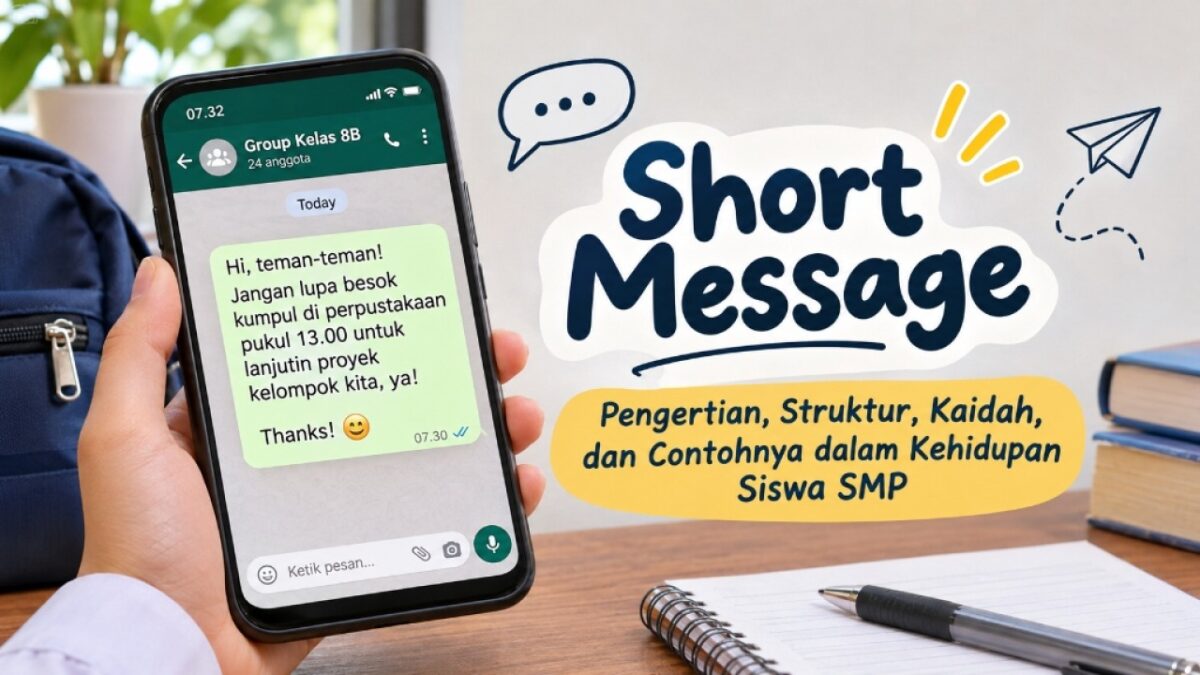
Example 8 – A Message About a Group Project
Don’t Forget Our Project!
Hi, everyone!
Let’s meet in the school library tomorrow at 1 p.m. We need to finish our group project about Indonesian animals.
Please bring your notes!
Kevin
Indonesian Translation: Hai, semuanya! Mari kita bertemu di perpustakaan sekolah besok pukul 1 siang. Kita perlu menyelesaikan proyek kelompok kita tentang hewan-hewan Indonesia. Tolong bawa catatan kalian! – Kevin
- Sender: Kevin • Receiver: All group members
- Purpose: Arranging a meeting and reminding group members.
- Language feature: Imperative (Please bring), suggestion (Let’s meet), and modal (need to).
6. How to Write a Good Short Message
Writing a short message is not difficult. You just need to know what you want to say and who will read it. Follow these five simple steps:
- Step 1 – Know Your Receiver: Who will receive your message? Your friend, teacher, parent, or classmate?
- Step 2 – Know Your Purpose: Do you want to inform, remind, invite, apologize, or ask for help?
- Step 3 – Write the Main Message: Use simple words and short sentences. Go straight to the point.
- Step 4 – Include Important Details: Add the time, date, place, or other information if necessary.
- Step 5 – Check Before Sending: Check your spelling, grammar, and punctuation. Make sure your message is polite and easy to understand.
7. Let’s Practice!
Now, it’s your turn! Read the messages and answer the questions.
Question 1
Hi, Andi!
Don’t forget to bring your science book tomorrow. We have a test.
Thanks!
Rudi
Who sends the message?
A. Andi | B. Rudi | C. The science teacher | D. Andi’s parents
Question 2
Hello, Siska.
Can you help me with my mathematics homework after school?
Rina
What is the purpose of the message?
A. To invite Siska to a party.
B. To apologize to Siska.
C. To ask Siska for help.
D. To remind Siska about a test.
Question 3
Hi, everyone!
Let’s meet in the library on Friday at 2 p.m.
Kevin
When will the students meet?
A. Thursday at 2 p.m. | B. Friday at 2 p.m. | C. Friday at 3 p.m. | D. Saturday at 2 p.m.
Answer Key
- B. Rudi
- C. To ask Siska for help.
- B. Friday at 2 p.m.
8. Remember These Important Points!
Before you finish, let’s review what we have learned.
| What to Remember | Explanation |
|---|---|
| Definition | A short written message to communicate something important. |
| Social Function | To inform, remind, invite, request, apologize, etc. |
| Main Structure | Receiver, Content, Sender. |
| Language Features | Simple sentences, imperative, tenses, modal verbs, pronouns, and expressions. |
| Writing Style | Clear, brief, polite, and appropriate to the receiver. |
One Last Thing! A good short message is not about how many words you write. It is about how clearly you deliver your message. Keep it short, keep it clear, and make it meaningful!
References for Further Learning:
- Kementerian Pendidikan dan Kebudayaan – Buku Guru Bahasa Inggris, Chapter 3: I Got a Message Here!
- Modul Belajar Mandiri Bahasa Inggris – Calon Guru PPPK.
- CNN Indonesia – Materi dan Contoh Short Message.
This learning material is adapted and developed for Junior High School English learners (Phase D), using simple language and familiar daily-life contexts.